
Skills for Europe's AI Future: AI skills webinar
Europe’s digital ambitions are clear: a thriving AI ecosystem that supports innovation, public value, and societal progress. In our recent webinar, “AI skills”, speakers highlighted that achieving this goal requires more than technical growth-it demands a rethink of how Europe educates, trains, and equips its AI workforce.
Europe’s digital skills landscape
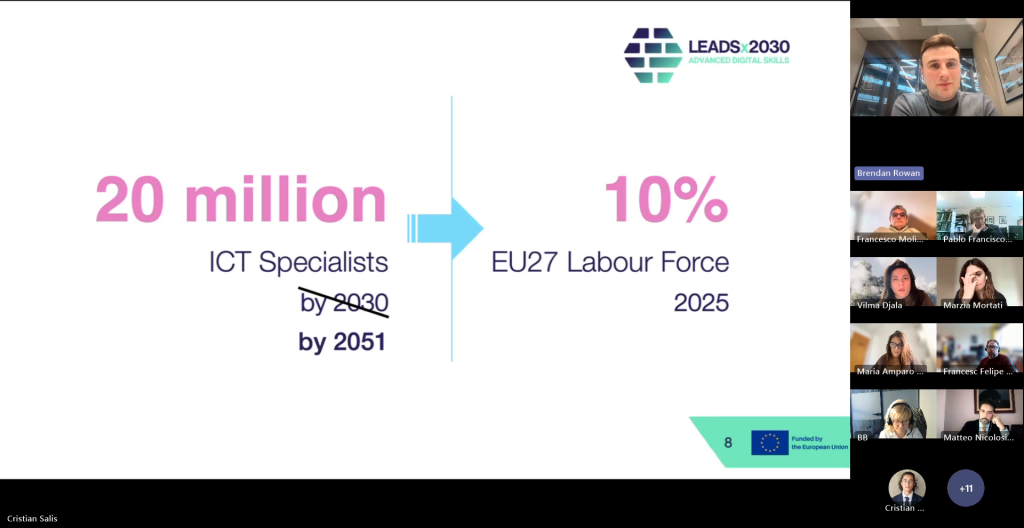
Brendan Rowan opened the webinar with a snapshot of Europe’s ICT workforce: the EU has nearly doubled its ICT workforce since 2011, now ranking as the second largest globally. Under the Digital Decade programme, 20 million ICT specialists are needed by 2030, but at the current pace of progress, this goal won’t be reached until 2051.
Today, ICT specialists make up only 5% of the European workforce, halfway to the target. Only 50% of ICT specialists are employed in the ICT sector itself. The other 50% are distributed across the wider economy in sectors including: manufacturing, professional services, finance & insurance and wholesale & retail.
The data on gender diversity in technology is fundamental, at the current pace of change, the goal of reaching 40% women in digital roles will not be achieved until the year 2087.
Over the last 10 years, the share of women in digital roles has only inched forward from 16.5% to 19.5%. With focused initiatives and inclusive policies, Europe can accelerate the inclusion of women in digital roles, creating a stronger, more innovative workforce.
The real issue is no longer a simple shortage, but a massive workforce replacement cycle. By 2035, Europe will need 4.2 million ICT professionals to maintain its current position. Of those, only 1.7 million are for net new growth; 2.5 million are needed simply to replace professionals lost to retirement and career changes.
High-demand areas include data science and cloud security, while less defined skills like quality assurance are declining. This highlights the need for clearer competence frameworks to guide training and education.
Rowan emphasised the shifting nature of demand: “It’s not occupation versus occupation anymore: data shows demand is rising at senior levels, valuing experience above all.”
AiSECRETT: human-centric, democratic and creative AI
Moving beyond workforce statistics, Pablo Francisco Rausell Koster introduced AiSECRETT, a project that challenges how AI itself is understood. Koster emphasised that AI is everywhere, but often misunderstood: “AI is not neutral, it shapes power and value,” he explained. AiSECRETT frames AI as a system of governance mediating knowledge, rights, and decision-making, rather than simply a tool.
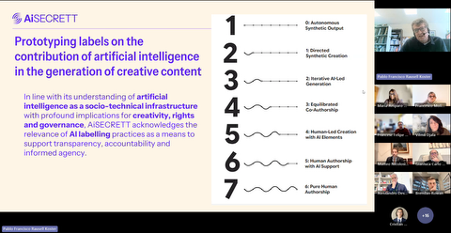
The project introduces the concept of European digital sovereignty as control over the full AI stack, not merely as an industrial or competitive goal. Its vision is guided by the Triple Transition, a model in which digital, green, and social dynamics evolve together rather than in isolation. The initiative also focuses on creative applications of AI, developing a Master’s degree in AI for Creativity and the Triple Transition. This programme trains professionals to use AI ethically, sustainably, and equitably to generate human, social, and environmental progress. Transparency is another cornerstone; AiSECRETT is prototyping labels to indicate the degree of AI contribution in content creation on a scale from one to seven. Koster urged participants to embrace a philosophy of depth, openness, locality, honesty, and governance in AI education.
AI4Gov-X: building AI capacity for the public sector
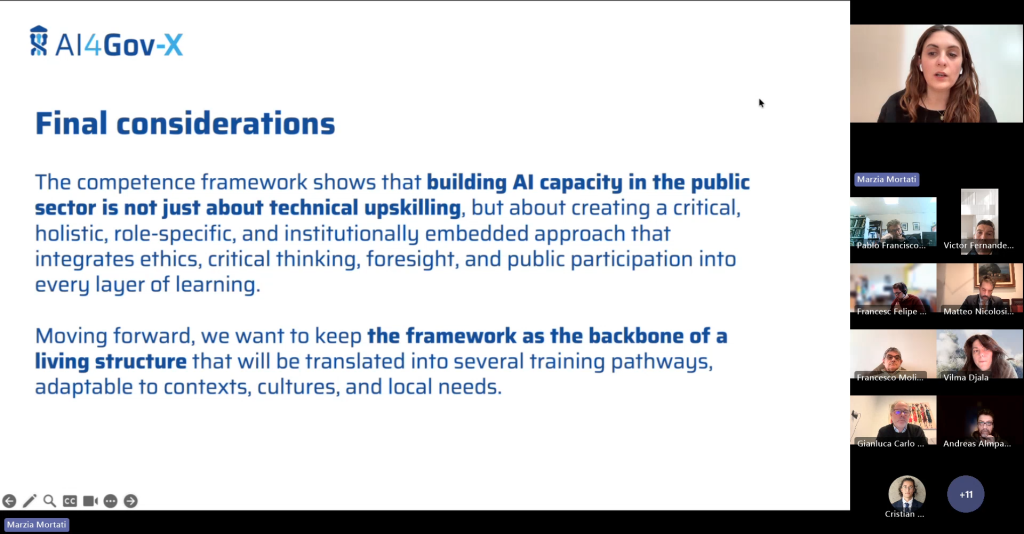
Gianluca Misuraca and Marzia Mortati presented AI4Gov-X, a European knowledge hub and network of excellence focused on AI in the public sector. The initiative aims to provide modular, multilingual training for specialists in AI, data science, and digital governance through a micro-credential certified system. The programme represents a departure from fragmented, short-term courses, offering structured and progressive learning that integrates knowledge, skills, and values. Its goal is to empower public sector professionals to manage digital transformation effectively, applying AI and data responsibly to create public value.
EMAI4EU: education and market needs in emotion AI
Vilma Djala, Education Lead at 28Digital, discussed EMAI4EU, which addresses Europe’s skills gap in Affective Computing, or Emotion AI. The project offers a double-degree Master’s programme with a specialisation in Emotion AI, alongside self-standing modules for upskilling and reskilling professionals.
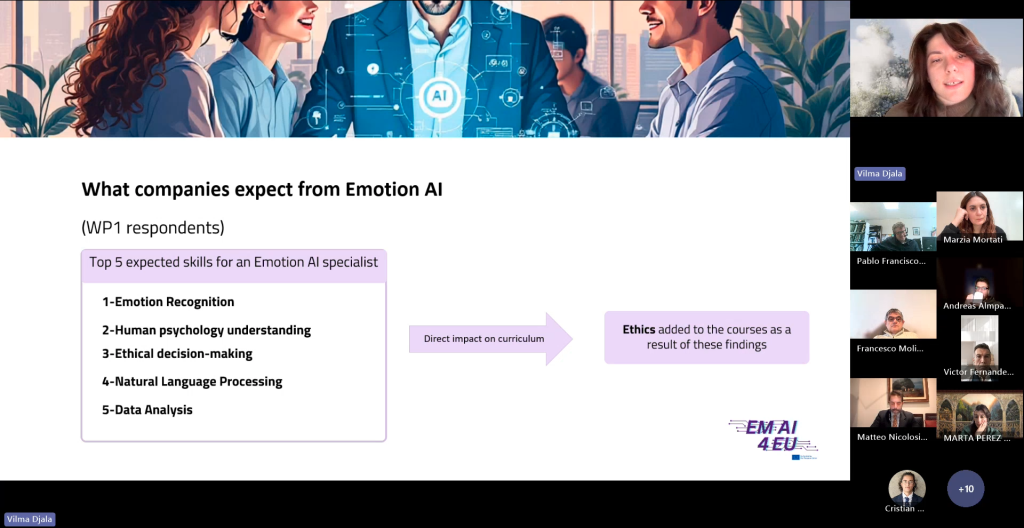
EMAI4EU is guided by a rigorous, evidence-based “backward design” approach. Market needs are first identified and translated into measurable learning outcomes, which then inform curriculum development. The project has highlighted a mismatch between the widespread use of basic AI tools in organisations and the advanced competencies required for strategic implementation. Companies participating in EMAI4EU identified top skills in Emotion AI as emotion recognition, understanding human psychology, ethical decision-making, natural language processing, and data analysis.
Key takeaways
The webinar highlighted a clear shift in Europe’s approach to AI skills. Across the three initiatives, there is a consensus on the importance of hybrid competencies, combining technical expertise with ethics, governance, and human-centred design. Education programmes must be market-driven and evidence-based, ensuring graduates are equipped for real-world challenges. Moreover, a values-driven, European approach underpins these initiatives, promoting transparency, democracy, and public value in AI development.
Europe’s AI success depends not just on increasing the number of specialists but on cultivating professionals who are smarter, ethically aware, and adaptable, ready to drive innovation, societal progress, and digital sovereignty.