
Data-driven talent pipelines in industry
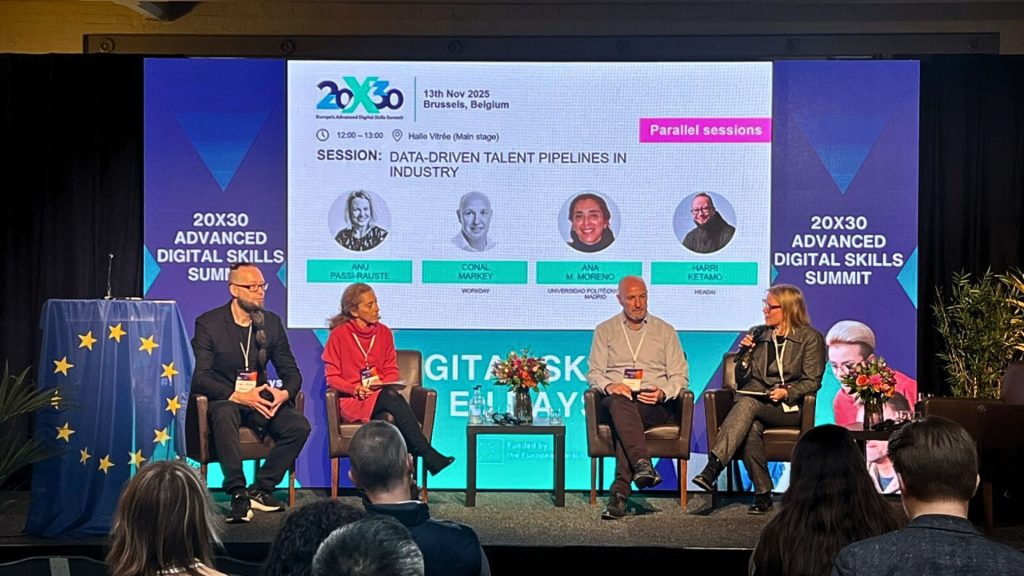
The modern workforce is evolving faster than traditional education can keep up with. Every day, industries demand new skills, and yet, university curricula often lag behind. So, how can we bridge this gap between academia and industry? The answer may lie in data-driven talent pipelines: a structured, ethical, and adaptive approach to preparing people for the jobs of tomorrow.
During the session “Data-Driven Talent Pipelines for Industry” at the 20×30 Advanced Digital Skills Summit, experts from academia, data science, and industry explored this challenge, offering insights into how we can better align education with real-world skill demands.
The academia-industry skills gap
One of the biggest obstacles is the disconnect between educational frameworks and the fast-changing needs of the labour market. Ana M. Moreno from Universidad Politécnica de Madrid (UPM) highlighted that universities often cannot quickly adjust their curricula in response to industry changes. To compensate, academic institutions are leveraging labour market data to create supplementary programs that provide students with relevant, up-to-date skills beyond traditional courses. While academia is slower to hinge, data provides a pathway to stay aligned with industry needs.
Constructing data-driven talent pipelines
Building an effective talent pipeline is more than collecting data, it’s about strategic design and interpretation. Harri Ketamo from Headai stressed that every pipeline must start with a clear objective and that high-quality data is essential.
“It is important to understand not just what the data shows, but also what it doesn’t.”
To pinpoint the skill demand, it has been analysed 3 million job vacancies across the EU which revealed 200,000 positions requiring Advanced Digital Skills (ADS). This highlights how data can identify specific skill pockets in demand. Data-driven pipelines transform raw numbers into actionable insights, guiding both education providers and learners.
Preparing for rapid skill evolution
Industries change fast, and teaching static skills is no longer enough. The focus must shift toward adaptability and fundamental knowledge. Conal Markey from Workday emphasised that programs should help people stay open to new developments and adapt to change.
This approach centres on a crucial “What is the essential knowledge that remain more or less stable through time?” By identifying this stable foundation, we can equip students and employees with the core competencies they need to adapt to any new tool or process.
It’s a common critique that academic institutions lack the “flexibility to change the curriculum” fast enough to keep pace with industry. However, Ana pointed to a deeper and more urgent problem: the need to “train the trainers.” For academia to truly meet the demands of the modern economy, resources must be directed toward helping teachers and professors understand this new landscape. There is an urgent need to empower educators so they can creatively develop the courses required to build that foundational, adaptable knowledge in their students. True transformation requires empowering the educators who deliver it.
Ethical data use and managing bias
Ana explained that data should ultimately serve to improve lives, requiring ethical and legal management in line with EU regulations and Harri highlighted the need to develop AI models with full awareness of their limitations, including understanding biases and avoiding manipulation. According to Ketamo, bias will always exist in data models, the goal isn’t to achieve the impossible task of eliminating them, instead, the responsibility is to make that bias visible and understandable.
“There are biases. There always have been. The key is that we have to be able to show our biases, to explain those biases.”
This transparency is achieved by communicating the “non-linear formula” that a prediction is built on and allowing users to check the sources. By making the inner workings clear, we can identify errors, challenge assumptions, and collectively improve the predictive model over time.
Beyond the data
These insights form a new playbook for talent strategy in the AI era: build durable foundations, empower the educators and demand transparency from technology partners. But we must also understand what the data doesn’t say. As we get better at using data to map the skills we need, how do we ensure we don’t lose sight of the human qualities that data can’t measure?