
20x30 Advanced Digital Skills Summit
Turning skills ambition into action
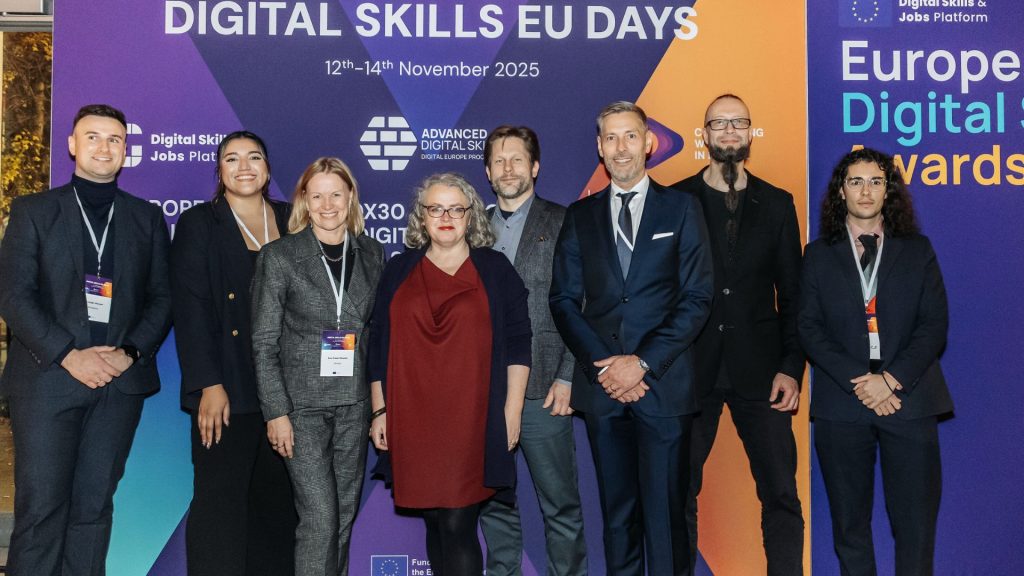
On November, the DIGITAL Skills EU Days reached full momentum as policymakers, industry leaders, educators, and innovators converged in Brussels for the 20×30 Advanced Digital Skills Summit, a day dedicated to confronting Europe’s most urgent digital talent challenges and shaping coordinated solutions for the decade ahead.
We kicked off with a high-level welcome from Renate Nikolay, Deputy Director-General at DG CNECT, reinforcing the urgency behind the Digital Decade target and the need to scale talent pipelines with speed and quality.
State-of-Play, centre stage
Next, Brendan Rowan (BluSpecs, Coordinator of LEADSx2030) presented the ADS State-of-Play – Key findings and results, setting the evidence baseline for the day. From a LEADSx2030 viewpoint, this moment mattered: it anchored every later debate in shared data about demand shifts, skills gaps, and where Europe is gaining ground or falling behind
See the State-Of-Play report here
The findings flowed straight into a panel discussion moderated by Anne Bajart (DG CNECT), with Member State leaders bringing national lenses to the shared European challenge: Fernando Escóbar Ruiz (Spain), Mojca Štruc (Slovenia), Anne Ribault-O’Reilly (Ireland), Iris Renoy (Belgium). For us, this was the ecosystem working as intended, evidence meeting policy, and policy stress-testing evidence
Industry playbooks for scale
We then shifted to “how do we actually do this at pace?” with Martina Wolfgruber from Infineon Technologies sharing Scaling Skills: An Infineon Playbook for Advanced Digital Talent. The takeaway for the cluster was clear: scaling talent needs more than courses, it needs repeatable models of employer engagement and training design that smaller actors can adapt.
Sub-clusters in action: best practices, position papers, and the messy middle.
After coffee, the summit moved into parallel sessions, where the SO4 Sub-Clusters did what they do best: share what’s working, what’s not, and what’s next.
- Data-driven talent pipelines in industry featured Anu Passi-Rauste (HeadAI), Isabela Paredes Cisneros (EMBL), Conal Markey (Workday), and Ana Moreno (UPM).
- Accreditation and the missing piece for skills recognition brought insights from Maria do Carmo Gomes (ISCTE Lisboa) and Chiara Demartini (University of Pavia).
- Achieving scale and sustainability in advanced programmes (workshop) was led by Minna Isomerusu (University of Oulu) and Martin Hayes (University of Limerick).
This is exactly where LEADSx2030 adds value: capturing these experiences, distilling patterns, and feeding them back into the cluster as reusable know-how.
Afternoon reality checks
Post-lunch, we heard frontline stories on AI Talent Development from Federico Menna (28Digital, moderator), Juan Riva (Immune Institute), Gonzalo Gómez (INETUM), and Erik O’Donovan (IBEC). They reminded us that AI adoption is not a future scenario, it’s already reshaping job roles and hiring bottlenecks.
In parallel, another panel tackled a thorny but hopeful question: Does the need for reskilling provide a window of opportunity for attracting new profiles into ICT? Moderated by Andrea Biancini, with Claudia Igbrude (PayPal), Petja Eklund (YTK, Finland), and László Gönczy (BME). The discussion echoed a key LEADSx2030 theme: reskilling isn’t a side-quest; it’s a main route to scale
Closing the loop: implications, not just insights.
The day’s culminating session, Navigating the challenges in advanced digital skills – insights and impact, was moderated by Tanya Suárez (BluSpecs), joined by Michele Tuccio (OECD) and David Timis (Generation). Together they pulled the threads tight, linking demand evidence, training delivery realities, and Europe’s competitiveness agenda into a shared challenge: we need faster, more inclusive, and more industry-relevant skills pipelines.
We closed with a forward look to 2026 from James Lawless, Irish Minister for Further and Higher Education, Research, Innovation and Science, an apt reminder that the Digital Decade target is not a slogan, but a policy commitment that depends on coordinated delivery.
Looking ahead to 2026
This wasn’t just another conference day. It was a full-arc moment: evidence → debate → best practices → policy implications → inclusion.
By the evening networking reception, it felt like Europe’s digital skills community had moved one stride closer to a shared playbook, not perfect, not finished, but real, and built together. The 20×30 ADS Summit and the Women in Digital Summit didn’t just run back-to-back; they reinforced each other’s message: Europe’s digital future depends on scale, relevance, and a workforce that is both skilled and truly inclusive.